The Final Word

There's something profoundly human about last words. We lean in closer, straining to hear them. We remember them long after everything else fades. They carry weight because they reveal what matters most when nothing else remains.
The cross gave us seven final statements from Jesus—each one a window into the heart of God. But the last word He spoke stands apart from all the others. It wasn't a cry of anguish or a declaration of victory. It was something quieter, yet infinitely more powerful:
"Father, into Your hands I commit My spirit."
These words, recorded in Luke 23:46, become more than Jesus' final breath—they become an invitation into a way of living that transforms everything. They show us that surrender is not defeat. Trust is not weakness. And endings in God's hands are never truly endings at all.
The Surrender That Looks Like Defeat But Isn't
We live in a world that worships control. We're taught from childhood to grip tightly, protect ourselves, and never let our guard down. Vulnerability gets labeled as weakness. Surrender sounds like giving up.
But Jesus redefines everything in this moment.
When He says, "Father, into Your hands I commit My spirit," He's not collapsing in defeat. He's not being forced into submission by circumstances beyond His control. He is *choosing*—deliberately, consciously, willfully—to place His life into the Father's hands.
These words echo Psalm 31, a prayer spoken in moments of distress: "Into Your hands I commit my spirit; deliver me, Lord, my faithful God." Jesus reaches back into the ancient prayers of His people and makes them His own. Even at the edge of death, He anchors Himself in the faithfulness of God.
This is the paradox of Easter faith: true strength is found not in clenched fists but in open hands.
The cross doesn't represent Jesus losing control—it represents Him trusting completely. And three days later, the resurrection proves that this trust was not misplaced. The Father who received His spirit returned it in resurrected glory. What looked like an ending became the greatest beginning in human history.
Trust That Holds When Everything Else Falls Apart
Throughout history, people of faith have looked to this moment as the ultimate picture of what it means to trust God in the darkness.
Augustine once wrote that Christ "commended His spirit to the Father, not because He feared the grave, but because He trusted the One who holds life itself." Jesus didn't cling desperately to life—He entrusted it.
This kind of trust stood in stark contrast to the Roman world that surrounded the early church. Roman culture prized power, control, and honor above all else. Yet Christians approached suffering and death differently. They faced persecution without terror, martyrdom without despair. Why? Because they believed what Jesus demonstrated: that life placed in God's hands is never truly lost.
The writer of Hebrews tells us that Jesus endured the cross "for the joy set before Him"—not because the cross itself was joyful, but because He trusted what lay beyond it. Paul later declares, "If we have been united with Him in a death like His, we will certainly also be united with Him in a resurrection like His."
The pattern is clear: resurrection follows surrender. New life emerges from trust.
This matters deeply for us because most of us won't face a Roman cross, but we will face moments that test our trust. We'll receive diagnoses we didn't expect. Watch relationships fracture. Pray prayers that seem to bounce off the ceiling. Stand beside graves and wonder if hope is just a beautiful lie we tell ourselves to get through the night.
In those moments, Easter faith doesn't demand that we understand everything. It invites us to trust anyway.
The resurrection confirms that Jesus' trust was not naive or misplaced. The Father received His spirit—and raised it in power. Death didn't get the final word. The grave couldn't hold Him. What Jesus placed in the Father's hands was gloriously, triumphantly returned.
And that means when we entrust our lives, our futures, our suffering, and even our deaths to God, we're not stepping into darkness—we're stepping into resurrection hope.
The Invitation That Changes Everything
Jesus' final word isn't just a statement—it's an invitation.
"Father, into Your hands I commit My spirit."
These words aren't reserved for Christ alone. They become the posture of everyone who follows Him.
At Easter, we rightly celebrate what God has done for us. The cross paid our debt. The empty tomb defeated death. The resurrection opened the door to eternal life. But Easter also asks something of us. It asks whether we're willing to trust God with our lives the same way Jesus did.
Not just with our theology, but with our control.
Not just with our eternity, but with our present.
Not just with our beliefs, but with our brokenness.
To commit something into someone's hands is an act of profound surrender. It means releasing self-reliance, self-protection, and self-salvation. In a world that tells us to stay in control, stay guarded, and stay strong, this kind of surrender feels risky.
But the resurrection tells us that surrender to God is never loss—it's the pathway to life.
Some of us are holding tightly to guilt we cannot erase. Others are clinging to shame we cannot outrun. Many of us are exhausted from striving, proving, earning, and performing—trying desperately to make ourselves acceptable to God or others.
Easter doesn't ask you to fix yourself first. It asks you to trust the One who has already finished the work.
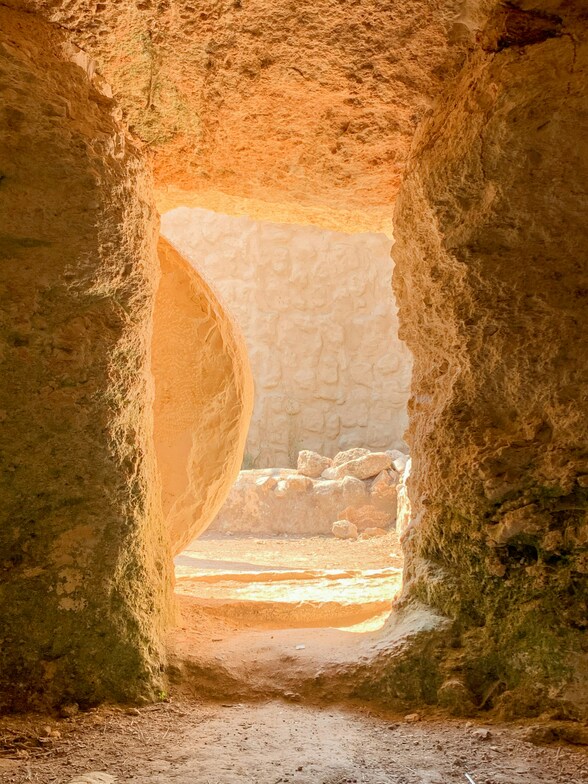
The empty tomb stands as God's response to Jesus' surrender. It declares that what we entrust to God, He redeems. What we place in His hands, He raises. What looks like an ending becomes a beginning.
Living as Resurrection People
When Jesus committed His spirit into the Father's hands, it looked like the end. The body was broken. The breath was gone. The disciples scattered in despair.
But resurrection proved it was only the beginning.
The same is true for everyone who chooses to surrender their life to God. Forgiveness is still available. Grace is still being offered. Hope is still alive. New life is still possible.
Easter doesn't end at the empty tomb—it begins there.
We live as resurrection people in a world desperate for hope. We walk in freedom because the work is finished. We trust God with our lives because Jesus has already gone before us, showing us the way.
And this is the good news that echoes from that empty tomb across two thousand years:
What looks like surrender is often the doorway to life.
What feels like the end is often God's beginning.
What we place in the Father's hands, He faithfully raises.
Christ is risen. And because He lives, we can live too—not just someday in eternity, but today, right now, in resurrection power.
The invitation stands: *Into Your hands, Father, I commit my spirit.*
Will you take the step?
-
City Light Church
Contact
Office Hours